

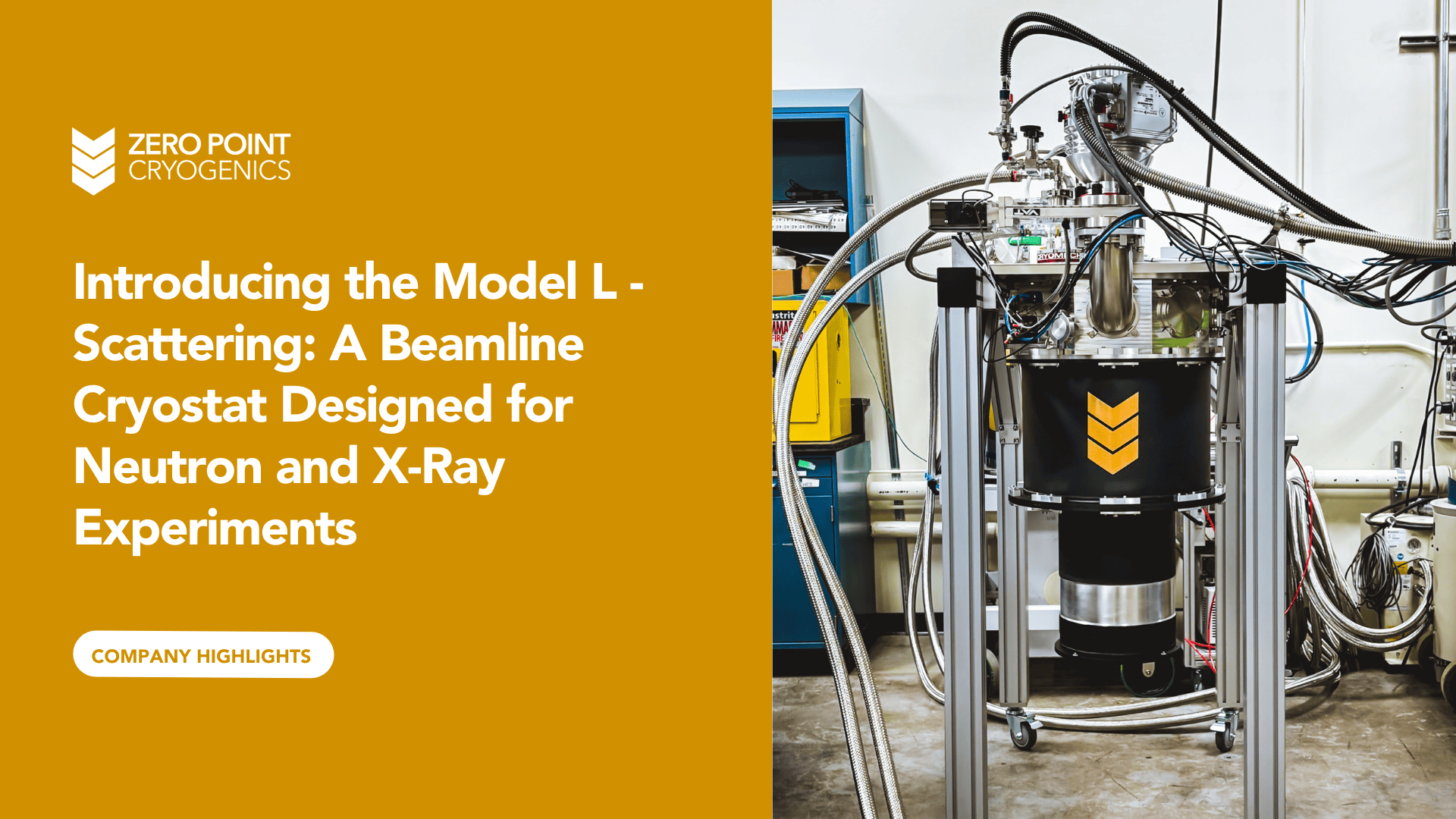
Introducing the Model L - Scattering: A Beamline Cryostat Designed for Neutron and X-Ray Experiments
Neutron and hard x-ray beamlines increasingly incorporate cryogenic sample environments as research into quantum materials, superconducting systems, magnetic phenomena, and other temperature-sensitive studies become critical for future technologies. Although these materials science tools have been available for decades, newer research into quantum materials has increased the demand for equipment that provides reliable low-temperature performance. This modern equipment also accommodates the complex sample geometries required in new fields of materials science and materials characterization, such as spectroscopy, neutron beam scattering, and x-ray imaging.
The Model L Scattering Cryostat was developed in response to this need. Built using the same dilution refrigerator architecture as the Zero Point Cryogenics (ZPC) Model L, and adapted for beamline operation, it provides millikelvin temperatures while supporting the workflows, sample access requirements, and installation considerations common to these experimental settings. The intention is to offer a cryogenic system that performs reliably in environments where sample geometries are atypical for a standard cryostat and beamtime is paramount.

Clear Access for Neutron and Hard X-Ray Studies
Neutron beam scattering and x-ray imaging are common tools within materials science and engineering, used to characterize the mechanical, structural, and electrical properties of novel materials at the molecular and atomic scale. Historically, these techniques have been challenging to implement for cryogenically cooled samples. Traditional cryostat designs often require thick structural supports or opaque thermal shielding that creates “blind spots,” limiting the usefulness of the imaging tools, especially in tomography applications.
Our new dilution refrigerator incorporates a 360-degree neutron or hard x-ray transparent window with matching specialized radiation shields. The sample sits directly on the mixing chamber plate within this unobstructed field of view, providing the incoming beam a clear path to the sample and the detectors. The cryostat is designed to be mounted on a goniometer and rotated up to 400 degrees for tomography experiments and imaging. This seamless arrangement supports a broad range of microscopy and spectroscopic techniques, including elastic and inelastic scattering, and wide-angle diffraction.
This specialized environment represents a shift for the study of emergent quantum phenomena at sub-kelvin temperatures. By suppressing thermal fluctuations, researchers can use conventional characteristic tools to probe magnetic and electronic structures in quantum environments. This system is ideal for investigating next-generation quantum materials, such as high-temperature superconductors, quantum spin liquids, and frustrated magnets.
Built from a Reliable Cryogenic Platform
The Model L Scattering Cryostat employs the same underlying dilution refrigerator design as the ZPC Model L, reaching a base temperature ~10 mK at the mixing chamber stage and maintaining stable operation during beam exposure. Higher temperature models, such as the patented Phase Separation Refrigerator (PSR) with a base temperature of 0.5 K, or the Continuous Cold Series of 1 K cryostats, are also available.
The dilution refrigerator, PSR, and Continuous Cold cryostats all share the same overall footprint and mechanical layout. This allows facilities to select the temperature range suitable for their research while maintaining consistency in handling, installation, and operation. The engineering emphasizes stability, predictable cooling performance, and straightforward thermal anchoring, which are essential in both laboratory and beamline environments.
Rotation Flexibility for Tomography
Common material characteristic studies include single-crystal scans, tomographic reconstructions, and combined in-situ studies, all of which require wide angular imaging access to the sample of interest. To support these techniques, the cryostat is designed to be moved, lifted, and rotated during operation to bring the sample into an x-ray or neutron beamline. Using flexible pumping lines and a carefully designed frame, the cryostat can be moved up to 15 ft and rotated on-axis up to 400 degrees, while preserving both vacuum integrity and base temperature. This flexibility allows researchers to orient their samples for complex measurement sequences without the need for cryogenic positioners.

Supporting the Realities of a Beamline Floor
Beamlines are dynamic spaces. Instrument configurations shift, experiments run on tight schedules, and cryogenic equipment must integrate into environments where crane handling and shared infrastructure are routine.
The Model L Scattering Cryostat was designed with these conditions in mind. It is crane-liftable and can be operated while suspended for alignment or integration. Once pre-cooled, the system can be disconnected from the gas-handling system, relocated into the beamline, and reconnected to continue cooling operations in the beam path without requiring a warm-up cycle. This reduces downtime and supports efficient scheduling for beamline experiments.
Integration with ZPC Cryogenic Infrastructure
Because the system uses the same dilution refrigerator architecture as other ZPC products, it connects directly to standard ZPC gas-handling systems. Facilities operating multiple ZPC refrigerators benefit from shared interfaces and consistent operational practices. For new installations, the unified layout helps simplify commissioning and long-term maintenance.
As more beamlines introduce low-temperature sample environments, this consistency supports smoother operation across different instruments and experimental setups.
How This System Can Support Your Research
The Model L Scattering Cryostat is suited for experiments that combine low temperatures with demanding geometries or sample requirements. Applications include:
- Elastic and inelastic neutron scattering on correlated, magnetic, or quantum materials
- Hard x-ray diffraction and spectroscopy at cryogenic temperatures
- Neutron imaging and tomography of low-temperature devices and materials
- Studies combining temperature control with magnetic fields, strain cells, or other in-situ environments
- Experiments that require continuous rotation or unrestricted angular access around the sample
- Experiments that require samples to be relocated without thermal cycling.
These applications reflect input from researchers, instrument scientists, and technical staff who regularly work within the practical constraints of beamline science.
Looking Ahead
Cryogenic capabilities continue to expand across neutron and x-ray facilities. As these techniques develop, the equipment supporting them must remain reliable, intuitive, and adaptable. Zero Point Cryogenics remains committed to developing systems that support these goals while reflecting the operational needs of research teams.
If your beamline or research program is exploring millikelvin or sub-kelvin measurements, we invite you to discuss how this system can support your work.
Zero Point Cryogenics – Colder for Longer
Zero Point Cryogenics manufactures cryostats and dilution refrigerators, which are the primary low-temperature platforms enabling quantum computing. The company is focused on designing robust and reliable dilution refrigerators to enable quantum technology research and innovation. ZPC is the only manufacturer of its kind in Canada and one of the few manufacturers of this technology in the world. The company is actively bridging the gap between customized and commercially scalable solutions, creating flexibility for quantum research and innovation while having the depth to scale. At Zero Point Cryogenics, we improve and iterate our designs based on customer optimization and are driven to build a product that stays colder for longer.
Contact our dedicated experts to discuss your cryogenic needs and visit our website to learn more at www.zpcryo.com.